
Sunflowers Program/Lanyard spreading all over the world

Travelling around the terminals in the airports can be so stressful and anxious.  It is hard for the disabled passengers to know/understand what to do as in regard to check-ins and where the gates are.  The noisy traffic environment can make them feel uncomfortable too. There was no one to ask and this is especially true to people with hidden disabilities.  Hidden disability means disabled people who look normal like everyone else but have an internal disability such as autism, ADHD, dyslexia and deafness.  There was an incident on my trip: – When I asked a flight attendant for pre-boarding and told her that I’m hearing impaired, she said that I looked normal and did not need it.  I was shocked and later she changed her mind and let me go pre-boarding.

Thanks to the Sunflowers Program/Lanyard for saving people with hidden disability.  It was originated by the Gatwick Airport (UK) and then spread to all UK airports, supermarkets, tourist attractions, hospitals and rail stations.  It is now spreading all over the airports in the world.  It is useful for the passengers with hidden disabilities so that they could get some help from the staff who work at the airports and for the airlines.  It is not compulsory but it is up to the disabled person to decide whether they need help or not. 

With the Sunflower lanyard, airport staff are not your personal assistance but can only help you for a short time such as point to the gate, point to the toilet, etc.  Good news is that they are trained by the Sunflower program so that they could identify passengers with sunflower lanyard and know how to communicate with them. 
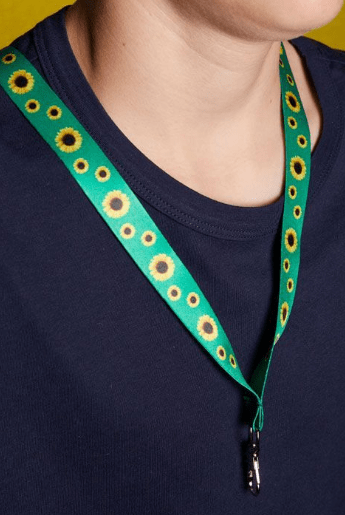
Sunflower lanyard (from Hidden Disabilities website)

It is very important for the passengers with hidden disabilities to know that not all the airports in Australia have sunflowers program.  If you need extra/personal assistance, then your airline service is the best place to help you.  Only the airlines can help you all the time from your local airport to your destination airport.  I would recommend travellers with hidden disabilities to ask airlines they are travelling with to help you not the airport staff in Australia.  If you are in UK/Europe, then it is the airport staff’s job to look after you (see another link). 
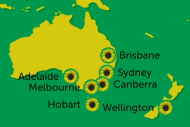
From Hidden Disabilities website’s video

Sunflower lanyard is free of charge and you can keep it forever.  You can get it free if you fill the form (14 days before travel) to the Australia airports who have Sunflower program.  No need to ask questions, proof of your disability.   If you want to buy it or other Sunflower’s products such as ID card, wristband, badge and wallet, it can be found in the following Australia website: https://hiddendisabilitiesshop.com.au/shop.html.  If you are outside Australia, choose other countries versions.

Not many airports are aware of the Sunflower program/lanyard yet however they are spreading all over world gradually.  It is not just for the airports but will be all over the places such as hospitals, shops, rail stations, wharves, hotels, museums, etc.  Hopefully, it will make our life as people of hidden disabilities a lot easier in the near future.

Who looks after disabled passengers at the airport?

Airlines (or with ground services) and Airports are working together to look after the passengers.  However, in some countries, they have different responsibilities and follow different regulations.

Here is the list of the countries that takes care of disabled passengers at the airports: –

Asia – Either airport nor ground service is looking after passengers at these airports (except Thailand).  Foreign airlines use ground services to look after passengers in these airports.

Australia and New Zealand – Local airlines look after passengers whereas foreign airlines use ground services to look after passengers at the airports.

Africa – No information can be found.

Europe – Most airports look after their passengers at their airports.

Middle East – Either airline nor airport looks after passengers at the airports.

North America – Local airlines look after passengers whereas foreign airlines use ground services to look after passengers at the airports.

South America – Different airports look after passengers at their airports.

You do not have to worry about calling the airports or ground services for the special assistance requests.  It is best to inform the airlines 48 hours before your travel starts.  They will organise your services and accommodate your needs at the airport.  However, they cannot guarantee that they would be able to help you because they may not have enough staff or properly trained staff to assist the type of disabilities that you may have.

Bonus: Some airports provide the lounge room and check-in room for the passengers with specific needs.  They provide them with free wifi, water, toys and magazines to read.

What to do if you can’t sit together with your friend.

If you and your friend cannot sit together because the plane tickets are separated, then you can log in “your booking” on the airlines’ website. You can then select one empty seat for you and your friend can select the next seat.

If the airlines website is not available or you do not want to pay to select seats, then you have to wait until the online check-in opens (24 or 48 hours before departure). Then you and your friend can select two seats together respectively.

If you are too late and your online check-in is closed, then you have to go to the airport for check-in. You can select the seats in self check-in computer or ask airlines check-in staff to change seats for you.

If they cannot change seats, then you need to go to the gate staff to check whether they are two seats together available.

If the gate staff cannot change seats because it is full, it is not the end of the world. Do not panic and do not argue with gate staff as there is nothing they can do for you. But they may promise you that they will ask flight attendant to help you to change seats.

If all the above fails, you might have one last chance to change seats. After you have boarded the plane, you have to wait for seat-taken passenger to come to the seat. Flight attendant will ask that passenger whether he/she be happy to move to another seat. Then you can sit with your friend together. Do not forget to say thank you to them.

If that passenger said no, do not fight and move on. Accept that. It is only a flight of several hours!

Sydney Airport offers free navigation service for the visually impaired.

“Participants normally sign up to a plan and pay for the service by the minute, but when they use the service at Sydney Airport, we’re happy to cover the cost to support the visually impaired community,” Sydney Airport CEO Geoff Culbert said.

Wow that is very impressive. Thank you Mr Culbert for offering free service for the visually impaired community.

Visually impaired travellers need to download the Aira app in their smartphones so that they can use it to navigate around the international and domestic terminals at the Sydney Airport 24/7.

Aira is a smartphone navigation app. It provides real-time guidance/navigation and information that help a visually impaired users to connect with Aira agents who are able to see the user’s surrounding area through either a phone camera or a smart glasses with a camera. Agents can instruct the users to find the location(s) around the terminal. It is wonderful to give the visually impaired travellers the confidence to travel independently without fear.

Here is the link of the Aira Website: https://aira.io/