A disabled woman waited to be assisted off the plane for 95 minutes

A disabled woman who is “paralysed from the neck down and could not use her arms or legs”, arrived at the Gatwick Airport (London’s second airport) from a holiday in Malta with British Airways.  She waited for more than 90 minutes for airport assistance to arrive. She needed two people (airport assistants) to lift her from the airplane seat to a narrow wheelchair, which is a specially designed for the plane, to push her along the aisle off the plane and then to her own wheelchair outside.  The British Airways staff were kind enough to help her to get off the plane so that the plane leave quickly.

But actually, it was not British Airways’ job, it was the duty of the Gatwick Airport assistance’s responsibility to look after disabled people on and off planes.  According to the British Airways’ disability and mobility assistance website, it mentioned that “they will liaise with the responsibilities of the airport operator or other service provider” to assist/escort disabled people to and from the aircraft and to transport them to their wheelchairs and mobility aids.

She received an apology from Gatwick Airport via Twitter.  She was not impressed with their services as “she did book the help in advance – she didn’t just turn up – and she again reminded them two weeks before as well”.  She has a plan to submit an official complaint that “the disabled people shouldn’t be stuck on a plane for that long and the UK airports need to get their acts together and plan their staffing appropriately.”

Gatwick Airport spokesman said that it was unacceptable to leave a disabled woman on the plane for so long and has given an apologize to her.  They are also investigating this incident as a matter of urgency.

YES, I have seen that myself.  Most airport assistance do not turn up so I have to go somewhere by myself.  I was told by the airline staff that they did not want to pay for the airport assistance services. For disabled people, it was free of charge, but for the airlines, they had to pay for appropriate staff to provide this kind of services.

The Guardian
BBC news

Airlines staff with hearing impaired passengers

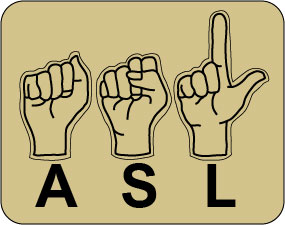
Here is the list of the airlines that provide sign language airline staff use to communicate with the hearing-impaired passengers.  You can find different type of “sign languages” on the badges under the staff names on their uniforms.

  • Air Canada (Badge reads ASL with fingers spelling)
  • Air China
  • American Airlines (Badge reads ASL)
  • ANA (All Nippon Airways) – Japan
  • British Airways
  • China Eastern Airlines
  • Delta (Badge reads ASL and other sign languages)
  • Japan Airlines (Pink badge with one hand that says I Love You/airplane symbol)
  • Lufthansa
  • Qantas (Badge with two hands that shows “sign language interpreter” symbol)
  • Turkish Airlines (Red badge with two hands that shows “I know sign language”)
  • United Airlines
  • Virgin Atlantic (British Sign Language only)
  • Virgin Australia (Badge with two hands that shows “sign language interpreter” symbol)

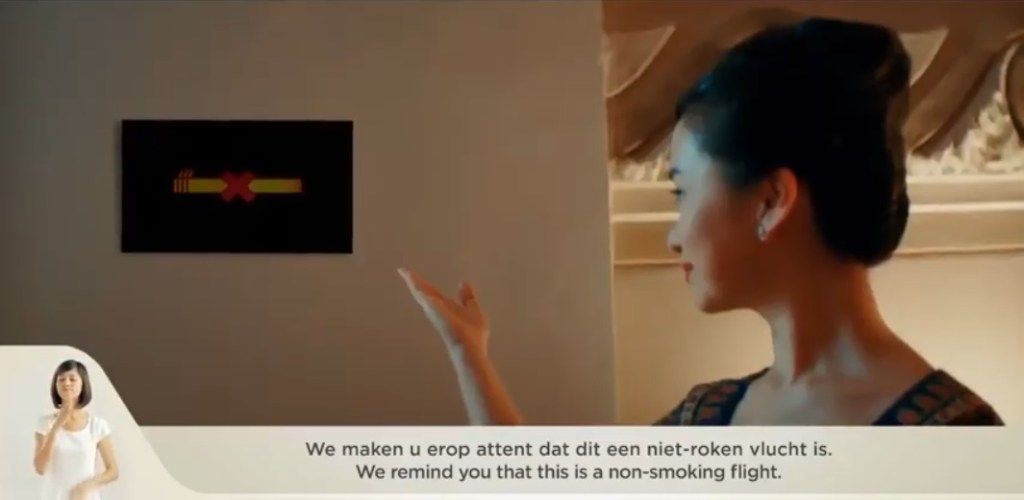
Extra: When you are watching the inflight safety demonstration that talks about where the emergency exits are, how to wear a lift jacket and how to use an oxygen mask, you can see a small sign language interpreter somewhere at the corner of the screen in most Asian airlines.

Singapore Airlines inflight safety video.

Sunflowers Program/Lanyard spreading all over the world

Travelling around the terminals in the airports can be so stressful and anxious.  It is hard for the disabled passengers to know/understand what to do as in regard to check-ins and where the gates are.  The noisy traffic environment can make them feel uncomfortable too. There was no one to ask and this is especially true to people with hidden disabilities.  Hidden disability means disabled people who look normal like everyone else but have an internal disability such as autism, ADHD, dyslexia and deafness.  There was an incident on my trip: – When I asked a flight attendant for pre-boarding and told her that I’m hearing impaired, she said that I looked normal and did not need it.  I was shocked and later she changed her mind and let me go pre-boarding.

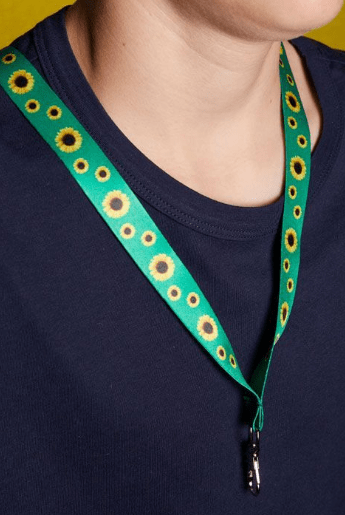
Thanks to the Sunflowers Program/Lanyard for saving people with hidden disability.  It was originated by the Gatwick Airport (UK) and then spread to all UK airports, supermarkets, tourist attractions, hospitals and rail stations.  It is now spreading all over the airports in the world.  It is useful for the passengers with hidden disabilities so that they could get some help from the staff who work at the airports and for the airlines.  It is not compulsory but it is up to the disabled person to decide whether they need help or not. 

With the Sunflower lanyard, airport staff are not your personal assistance but can only help you for a short time such as point to the gate, point to the toilet, etc.  Good news is that they are trained by the Sunflower program so that they could identify passengers with sunflower lanyard and know how to communicate with them. 

Sunflower lanyard (from Hidden Disabilities website)

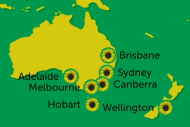
It is very important for the passengers with hidden disabilities to know that not all the airports in Australia have sunflowers program.  If you need extra/personal assistance, then your airline service is the best place to help you.  Only the airlines can help you all the time from your local airport to your destination airport.  I would recommend travellers with hidden disabilities to ask airlines they are travelling with to help you not the airport staff in Australia.  If you are in UK/Europe, then it is the airport staff’s job to look after you (see another link). 

From Hidden Disabilities website’s video

Sunflower lanyard is free of charge and you can keep it forever.  You can get it free if you fill the form (14 days before travel) to the Australia airports who have Sunflower program.  No need to ask questions, proof of your disability.   If you want to buy it or other Sunflower’s products such as ID card, wristband, badge and wallet, it can be found in the following Australia website: https://hiddendisabilitiesshop.com.au/shop.html.  If you are outside Australia, choose other countries versions.

Not many airports are aware of the Sunflower program/lanyard yet however they are spreading all over world gradually.  It is not just for the airports but will be all over the places such as hospitals, shops, rail stations, wharves, hotels, museums, etc.  Hopefully, it will make our life as people of hidden disabilities a lot easier in the near future.

Who looks after disabled passengers at the airport?

Airlines (or with ground services) and Airports are working together to look after the passengers.  However, in some countries, they have different responsibilities and follow different regulations.

Here is the list of the countries that takes care of disabled passengers at the airports: –

Asia – Either airport nor ground service is looking after passengers at these airports (except Thailand).  Foreign airlines use ground services to look after passengers in these airports.

Australia and New Zealand – Local airlines look after passengers whereas foreign airlines use ground services to look after passengers at the airports.

Africa – No information can be found.

Europe – Most airports look after their passengers at their airports.

Middle East – Either airline nor airport looks after passengers at the airports.

North America – Local airlines look after passengers whereas foreign airlines use ground services to look after passengers at the airports.

South America – Different airports look after passengers at their airports.

You do not have to worry about calling the airports or ground services for the special assistance requests.  It is best to inform the airlines 48 hours before your travel starts.  They will organise your services and accommodate your needs at the airport.  However, they cannot guarantee that they would be able to help you because they may not have enough staff or properly trained staff to assist the type of disabilities that you may have.

Bonus: Some airports provide the lounge room and check-in room for the passengers with specific needs.  They provide them with free wifi, water, toys and magazines to read.

New air travel rules during Coronavirus (COVID-19) crisis

You must know the new rules before you travel by air after Coronavirus (COVID-19) crisis. It will not be the same as before. Things will look very different at the airports and planes. It is called the “new” normal. Some experts believe that it will last for two or three years. There will be less contact between you and the airline employees for protection against Coronavirus disease.

Before you travel, you need to know: –

    • If you are sick, DO NOT travel. Call the airlines to postpone or cancel your trip.
    • If you are well, you may have to bring: –
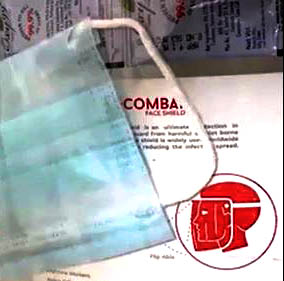
        • some face masks (Most European, Asian and North American must wear them – see their government websites)
          mask1
        • pairs of rubber gloves
          gloves
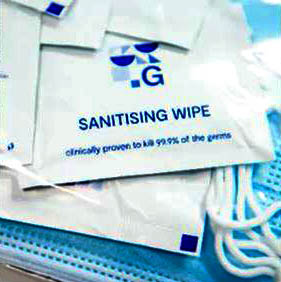
        • a small box of tissue paper or anti-bacterial wipes
          wiping
        • a small bottle of hand sanitiser
        • your digital boarding pass (by using online check-in on either computer, your mobile phone, tablets).

At the airport, you may find signs/floor markings that tell you what to do and may need to: –

    • bring your digital boarding pass (in your mobile phone or tablets)
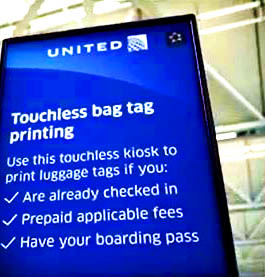
      use a self-service check-in kiosk to print your bag tags for your checked luggage. Do not worry about touching the screens. They are cleaned frequently.
      kiosk
    • put your checked luggage in the Bag Drop.
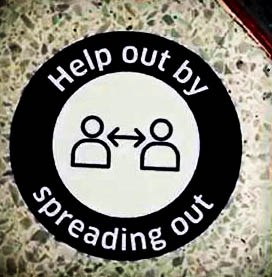
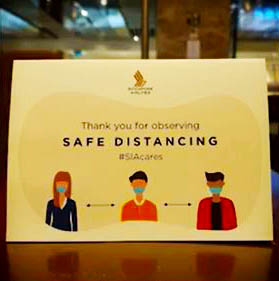
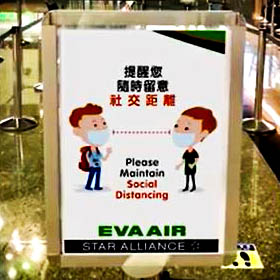
    • Then walk to the gate (DO NOT FORGET the Social distance – keep 1.5m (or 2m) away from you and the people around you)
      socialdistance

At the departure gate, you may find the signs/floor markings that tell you what to do and may: –

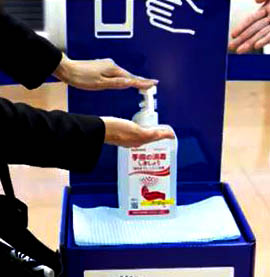
    • find hand sanitising station if you want to clean your hands.
      Handsantisingstation
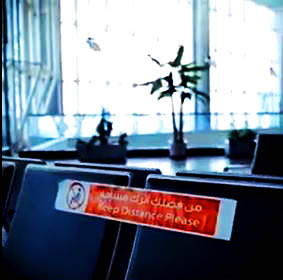
    • sit on seats if you want to. Do not sit close to the passengers – still keep 1.5m (or 2m) distancing between two people.
      seatdistance
    • keep safe distance while walking, queueing up to the gate door.
      socialdistance1
    • bring your digital boarding pass to scan on the ticket machine.
    • walk through the passenger bridges.
    • If the passengers stop in front of you, then you must stop in 1.5m (or 2m) away from them and wait.

On board, you can: –

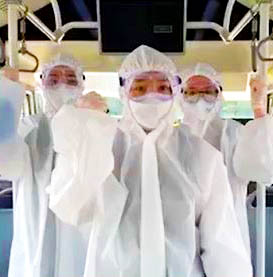
    • Smile and say hello to flight attendant at the entrance door. You can see flight attendants wearing face masks and other personal protective equipment. It is not easy for deaf people like me to hear what they are saying because it is impossible to lipread!
      protectiveclothes
    • Do not hand out your digital boarding pass to a flight attendant. They do not want to touch it. Just show them on your mobile phone screen and KEEP DISTANCE between you and the flight attendant. He/She will guide you to find your seat.
      socialdistance2
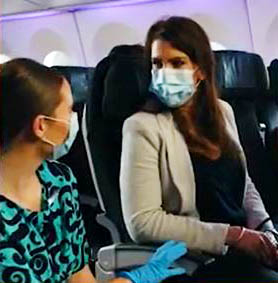
    • You can see that passengers are not allowed to seat together. The middle seat should be empty between two passengers. (Some airlines cannot guarantee this kind of distancing).
      boarding
    • After the plane door closed, you are not allowed to change seats and must stay on your seat until after landing. Try to reduce your walking around in the aisle throughout the flights except going to the toilet!
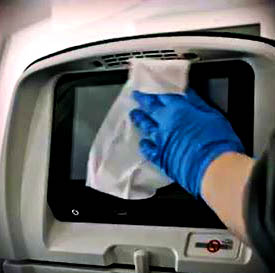
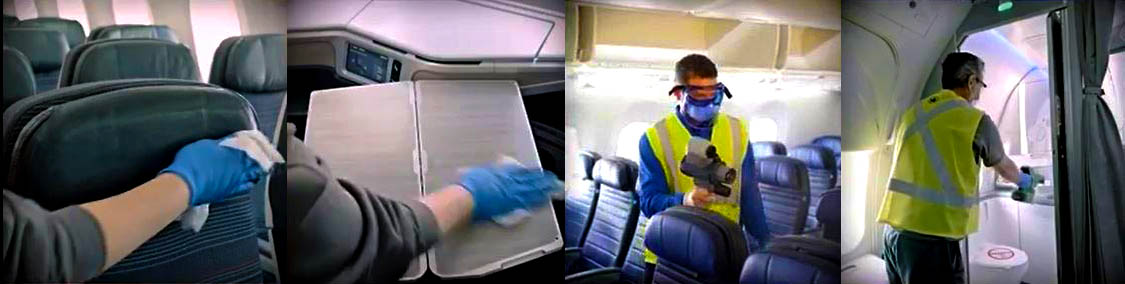
    • You will notice that the air looks refreshed and clean because it has been disinfected by using hospital-grade HEPA filter that can kill viruses and bacteria including Coronavirus inside the cabin every three minutes. All the seats, armrests, tray tables, overheads and windows are all cleaned by hand.
      cleaning
    • The inflight service will be simple – food and drink have been reduced and no inflight entertainment.
      drinks
    • Some airlines do not accept cash anymore. Please use a credit card for any purchases (such as ordering food).

Happy flying. The most important is to bring your digital boarding pass in your mobile phone or tablet in order to avoid queues and save time and bring your spare masks with you. You can find more information from your airline’s websites.

All photos were taken from a Star Alliance video clip.

What to do if you can’t sit together with your friend.

If you and your friend cannot sit together because the plane tickets are separated, then you can log in “your booking” on the airlines’ website. You can then select one empty seat for you and your friend can select the next seat.

If the airlines website is not available or you do not want to pay to select seats, then you have to wait until the online check-in opens (24 or 48 hours before departure). Then you and your friend can select two seats together respectively.

If you are too late and your online check-in is closed, then you have to go to the airport for check-in. You can select the seats in self check-in computer or ask airlines check-in staff to change seats for you.

If they cannot change seats, then you need to go to the gate staff to check whether they are two seats together available.

If the gate staff cannot change seats because it is full, it is not the end of the world. Do not panic and do not argue with gate staff as there is nothing they can do for you. But they may promise you that they will ask flight attendant to help you to change seats.

If all the above fails, you might have one last chance to change seats. After you have boarded the plane, you have to wait for seat-taken passenger to come to the seat. Flight attendant will ask that passenger whether he/she be happy to move to another seat. Then you can sit with your friend together. Do not forget to say thank you to them.

If that passenger said no, do not fight and move on. Accept that. It is only a flight of several hours!

Delta has listened to the deaf customers who complained about communication issue

Finally, it is time to break the barrier – Delta has introduced a language badge with options for more than 300 sign languages on their employee’s uniforms. It is placed under their name tags.

A deaf couple complained and planned to sue Delta because they felt that they were being discriminated by the Delta gate agent. The Delta gate agent, however, said that there was a communication issue with this deaf couple in January 2019. Though there was no further details for this incident, it still a relief to hear that Delta did listen to the customers’ feedback and has hoped to improve communication (or to make a better connection) between Delta team members and deaf customers.

I know that Virgin Australia and Qantas staff also wear a sign language badge on their uniforms if they know sign language. However, not all deaf people sign: some lipread or prefer things written in notes for them. Not all the airlines staff know sign language, here is the link to the list of airlines that has trained sign language airline staff.

I (as being deaf) have flown with Virgin Australia, Qantas and other foreign airlines. I have never seen any single flight attendant who knows sign language or wears a sign language badge on their uniforms. (I have always let airlines know that I’m hearing impaired on the airlines’ itinerary and the airlines also acknowledge my special assistance request). Wish I could meet or chat with them one day.

Brave Delta Airline flight attendant helps an Autistic passenger

Flying with disabled children can be very stressful for parents.

A Delta flight attendant, Amanda, went above the beyond when she saw an autistic child who refused to be calmed down during flying. No matter how hard his mother tried, this child kept crying. Amanda felt empathy and wanted to help this mother. She told mum that she would show him around the cabin but mum warned her that her son could be aggressive as he was not accustomed to other adults outside his immediate family. Amanda did not mind and invited him to take a tour of the plane. She comforted mum that she had experiences as a volunteer with Special Olympics in high school.

The mother was surprised to see her son became calm and well behaved quickly. He was able to make friends with Amanda and mum thanked her for being so kind to her son.
Another surprise for Amanda was when another passenger from a few rows away told her that “he has never seen a flight attendant do this and that he really appreciated it”. This passenger also has a son who is autistic.

Senior Vice President of Inflight service was pleased with Amanda’s kindness and wrote “This exemplifies Delta difference in every way” and she said “Service from the heart is what we’re all about and I’d like to thank Amanda and Delta employees around the globe for showing thoughtful service like this to the world”

Delta News

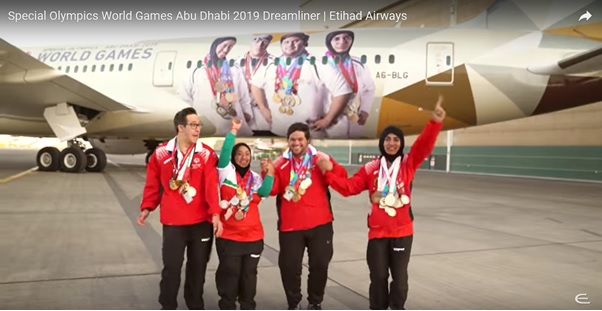
Etihad painted the four Special Olympics athletes on a Boeing 787

Four local Special Olympics athletes were so happy to see their images on the 787 aircraft. It is for the promotion of the Special Olympics World Game which was held between 14-21 March 2019 at Abu Dhabi (where Etihad’s home is) for the whole world to see their local heroes.

All Etihad flight attendants had done e-learning course so that they can understand how to assist passengers with intellectual disability.

Etihad is proud to be the official airline partner of the Special Olympics World Game Abu Dhabi 2019.

etihad

From Etihad youtube

Etihad News

Sydney Airport offers free navigation service for the visually impaired.

“Participants normally sign up to a plan and pay for the service by the minute, but when they use the service at Sydney Airport, we’re happy to cover the cost to support the visually impaired community,” Sydney Airport CEO Geoff Culbert said.

Wow that is very impressive. Thank you Mr Culbert for offering free service for the visually impaired community.

Visually impaired travellers need to download the Aira app in their smartphones so that they can use it to navigate around the international and domestic terminals at the Sydney Airport 24/7.

Aira is a smartphone navigation app. It provides real-time guidance/navigation and information that help a visually impaired users to connect with Aira agents who are able to see the user’s surrounding area through either a phone camera or a smart glasses with a camera. Agents can instruct the users to find the location(s) around the terminal. It is wonderful to give the visually impaired travellers the confidence to travel independently without fear.

Here is the link of the Aira Website: https://aira.io/